
Airway and Orthodontics: What Expanders and Bite Plates Really Do
The appointment is over, your child is buckled in, and one phrase keeps replaying in your head: expander. Or maybe it was bite plate. Meanwhile, this is also the child who snores, breathes through their mouth, or always seems a little restless at night, so now the question feels bigger than straight teeth. Are we talking about breathing, bite correction, jaw growth, or some mix of all three?
We hear this kind of confusion all the time at Textbook Orthodontics, and honestly, it makes sense. “Airway” has become one of those words people hear in different offices, online videos, and parent conversations without always getting a clear explanation of what it actually means in orthodontics. Our job is to slow that down, separate hype from reality, and help families and adults understand what orthodontic treatment may support, what it cannot promise, and why the right next step is often a thoughtful evaluation rather than a rushed appliance decision.
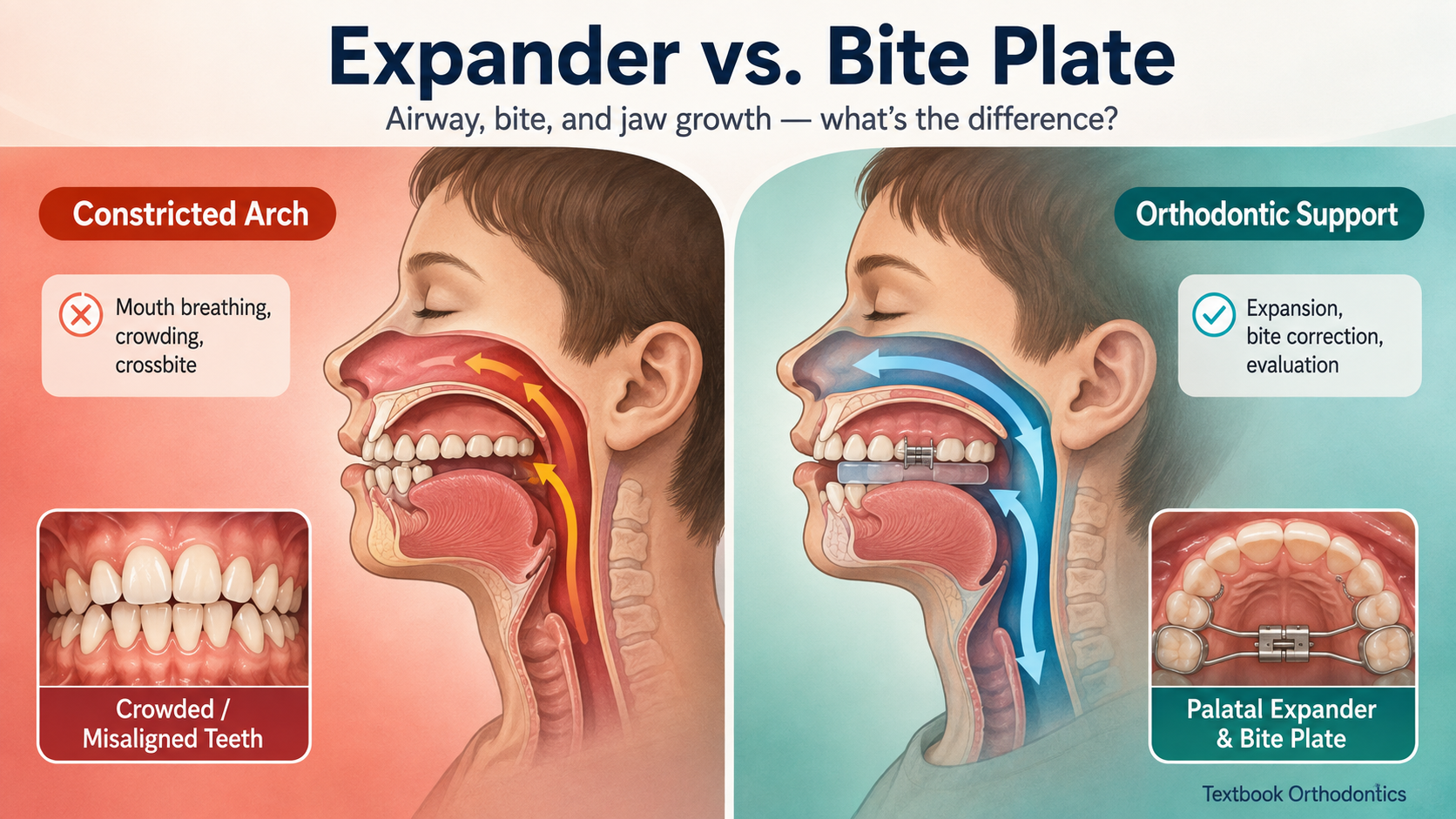
When breathing, snoring, mouth breathing, or jaw-growth concerns come up, we are no longer talking only about appearance. We are looking at how the upper and lower jaws fit together, how wide the upper arch is, whether a crossbite or deep bite is present, how the teeth are erupting, and whether growth is happening in a way that may benefit from monitoring or treatment. Straight teeth can matter, but they are not the whole story.
That is why airway-adjacent orthodontic questions can feel so loaded. A child with a narrow upper arch may also mouth breathe. An adult with a bite problem may also wonder whether jaw position is affecting comfort or sleep quality. Sometimes those concerns overlap in meaningful ways. Sometimes they do not. And sometimes the orthodontic finding is real, but it still does not mean one appliance is going to “fix the airway” by itself.
Can orthodontic treatment help with airway-related concerns?
Sometimes, yes. Universally, no.
That is the most honest answer we can give. In the right case, orthodontic treatment may support healthier function by addressing problems like a narrow upper arch, a crossbite, a deep bite, or growth-related bite issues. If a child has a constricted palate and the upper jaw needs orthopedic expansion for real bite and growth reasons, that treatment may also relate to the bigger conversation about space and function. If someone has a bite pattern that is affecting jaw posture or tooth eruption, a bite plate may play a useful role in improving that mechanical setup.
But orthodontics is not a guaranteed cure for breathing problems, snoring, or sleep disorders. Those concerns can involve the nose, tonsils and adenoids, soft tissues, habits, allergies, sleep quality, and medical factors far beyond tooth alignment. That is why we are careful with our language. We can evaluate how the bite, arch form, and growth pattern may be part of the picture, but we do not promise that braces or a small appliance will solve every airway-related symptom.
In many cases, the best care is team-based. An orthodontic evaluation may be one important piece, while a general dentist, pediatrician, ENT, or other physician helps assess the rest of the picture. That is not a sign that treatment failed before it started. It is a sign that the problem is being taken seriously enough to look at it from the right angles.
These appliances are not interchangeable
One reason families get overwhelmed is that appliance names start blending together. An expander is not just another version of a bite plate, and an anterior bite plate is not simply a different brand of the same thing. These tools do different jobs.
A palatal expander
A palatal expander is used to widen the upper arch when the upper jaw is too narrow. In plain English, it is about transverse width. We think about it when there are issues such as a narrow palate, crossbite, crowding patterns tied to arch constriction, or growth situations where expanding the upper jaw is mechanically meaningful.
This is the appliance people most often connect to airway conversations, and that is where nuance matters. If a child truly has a narrow upper arch, expansion can be important for bite development and may support the larger functional picture. But the reason to use an expander should be grounded in real orthodontic findings, not in vague hope alone. We do not treat “airway” as a magic justification for expansion if the anatomy and bite do not support it.
In younger patients, timing can matter because growth creates opportunities that are different from adulthood. In adults, expansion questions are usually more limited and more case-specific, which is one reason a specialist evaluation matters so much.
A bite plate
A bite plate is a broader category of appliance used to change how the teeth come together. Its job is not to widen the upper jaw. Instead, it helps us manage bite mechanics. We may use one when a deep bite is preventing proper tooth movement, when certain teeth need to be discluded so others can move, or when the way the bite fits together is blocking healthier development.
Functionally, this matters because a poor bite relationship can affect more than appearance. It can influence eruption, tooth wear, comfort, and how the jaws interact. A bite plate may be part of creating the right conditions for better orthodontic correction, but it is not an airway appliance in the way people often imagine online. It is a bite-management tool.
An anterior bite plate
An anterior bite plate is a more specific version that contacts the front teeth and opens the bite in a targeted way. We often use it when we need to take pressure off the back teeth temporarily, unlock a deep bite, help with certain crossbite situations, or allow specific tooth movements that are being blocked by the existing bite.
Because it changes the way the front and back teeth touch, it can be extremely useful in the right case. But again, its purpose is mechanical and orthodontic. It is not interchangeable with an expander, and it is not automatically chosen because someone mouth breathes or snores. If an anterior bite plate is recommended, it should be because the bite itself needs that kind of correction.
Who may benefit now, later, or not yet
Children and adults do not get the same answers here, because growth changes what is possible and when. For a growing child, we may see a narrow upper arch, crossbite, or other pattern where early intervention could be helpful not just cosmetically, but developmentally. That does not mean every child needs treatment the moment a symptom shows up. It means we want to know whether there is a true growth-and-bite issue worth addressing during a useful window.
Some children are best treated now. Some are better watched over time. A careful orthodontic exam may end with, “Let’s monitor this for six months,” and that can be the right answer. Monitoring is not doing nothing. It is a decision based on growth timing, eruption, bite changes, and whether treatment would be more effective a little later.
Adults can absolutely benefit from orthodontic treatment, including treatment that improves bite function, comfort, and arch coordination. But adults should also know that growth-based options are different once the jaws are mature. That does not make treatment hopeless; it just means the plan has to be realistic about what orthodontics can and cannot change.
What a good airway-aware orthodontic evaluation actually looks at
This is where we believe specialist planning matters. A strong evaluation is not just a quick glance at whether teeth look crowded. We look at records, photos, and imaging, assess the bite from multiple angles, study arch form and jaw relationships, and consider symptoms in context. If mouth breathing, snoring, or growth concerns are part of the reason you came in, those details belong in the conversation from the start.
At Textbook Orthodontics, we use modern digital tools, including 3D scanning, to understand what is going on without turning the visit into a sales pitch. We also think continuity matters. Seeing the same orthodontist at each visit helps when a case involves growth, function, or the possibility of staged treatment, because families should not feel like they are getting a different theory every time they sit in the chair.
Sometimes that evaluation leads to treatment. Sometimes it leads to observation. Sometimes it leads to collaboration with a dentist, pediatrician, or ENT because the orthodontic findings are only part of the picture. That range of outcomes is a good sign. It means the recommendation is being built around the patient, not around forcing everyone into the same appliance.
What to bring into the consultation mindset
If you are trying to decide whether now is the right time to schedule, it helps to pay attention to patterns rather than isolated worries. We do not need you to arrive with a diagnosis. We just want a clearer picture of what has been happening and what other providers may already have noticed.
Whether you notice regular mouth breathing, snoring, or restless sleep
Any history of a dentist mentioning a narrow arch, crossbite, deep bite, or crowding
Whether the concern seems new or has been ongoing during growth
Any prior recommendations for an expander, bite plate, or early orthodontic monitoring
Questions about timing, affordability, or whether treatment would likely be staged
The next step does not have to feel high-pressure. A consultation can simply help answer: do we treat, watch, or refer? For many families in Los Angeles, the San Fernando Valley, Whittier, and nearby communities, that clarity is the biggest relief. And because we offer free consultations that include x-rays and photos, the first visit can be about understanding the case before making any big commitment.
A few common worries we can clear up
Does this mean my child needs braces right away?
Not necessarily. Sometimes the best first step is a limited appliance, sometimes it is observation, and sometimes full treatment is better later. An airway-aware orthodontic visit should reduce pressure, not create it.
Can orthodontics fix airway problems by itself?
Not as a blanket promise. Orthodontics may support function in the right structural cases, but breathing and sleep concerns can involve much more than tooth position or jaw width. That is why we are careful to set realistic expectations and involve other providers when needed.
If an expander was mentioned, does that automatically mean the issue is airway-related?
No. An expander may be recommended for important orthodontic reasons such as a narrow upper arch or crossbite. Those reasons may overlap with broader functional concerns, but they are not the same thing.
What if we are mainly worried about cost?
That is a real concern, and it should be part of the conversation. We work hard to make specialist orthodontic care accessible with affordable monthly payments, 0% interest financing, no credit checks, and acceptance of PPO insurance and Medi-Cal. If you are unsure whether this is a “maybe later” issue or something worth evaluating now, a free consultation is often the simplest way to get a grounded answer without adding more guesswork.
If you are in Los Angeles or nearby and trying to make sense of mouth breathing, snoring, jaw-growth questions, or a recommendation for an expander or bite plate, we would be glad to help you sort out what is actually going on. Sometimes the answer is treatment. Sometimes it is watchful monitoring. Sometimes it is team-based care. What matters most is getting a clear, honest evaluation from the start, the Textbook way.
Get a clear evaluation before guessing
Textbook Orthodontics offers free consultations with x-rays and photos to help determine whether treatment, monitoring, or referral makes the most sense. You will get honest guidance, modern digital records, and a plan built around the real findings.
Affordable monthly payments, 0% interest financing, and PPO / Medi-Cal acceptance available.