
Palatal Expander (RPE) in Los Angeles, CA
The palatal expander at Textbook Orthodontics is used to correct jaw width, dental crowding and crossbites. It is best to bring your children to see an orthodontist for an orthodontic exam at the age of 7. At this age an RPE can still make skeletal changes that can avoid both orthodontic surgery and teeth removal in the future.
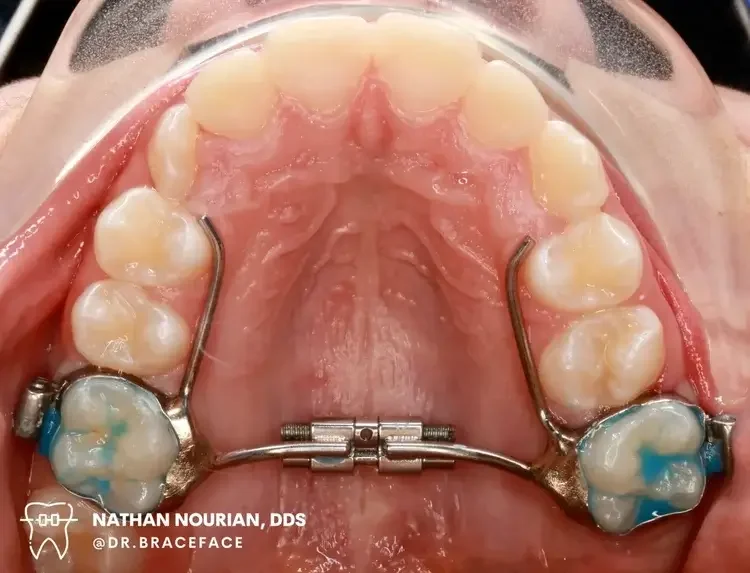
What Is a Palatal Expander?
A palatal expander, also called a rapid palatal expander (RPE), palate expander or dental expander, is a custom appliance that attaches to the upper back molars and gently widens the upper jaw. In children, the two halves of the upper jaw are joined by a growth seam called the midpalatal suture. Until that seam fuses, small daily turns of the expander's center screw slowly separate it, and new bone fills in the space. The result is a wider upper jaw that fits correctly over the lower jaw, with more room for adult teeth to come in.
Signs Your Child May Need a Palate Expander
Crossbite
The upper back teeth bite inside the lower teeth on one or both sides.Crowding
There isn't enough room for the adult teeth to come in straight.Narrow smile or high palate
A tapered upper arch, often with dark spaces at the corners of the smile.Mouth breathing or snoring
A narrow upper jaw often goes along with a narrow nasal airway.Blocked canines
Adult canine teeth with no space to erupt.Jaw shifting
The lower jaw slides to one side so the teeth can fit together.
Why Ages 7 to 10 Are the Best Time
The American Association of Orthodontists recommends that every child have an orthodontic check by age 7. Between about 7 and 10, the palatal suture is still open, so a standard RPE can widen the jaw itself instead of just tipping the teeth. Correcting a narrow jaw early can reduce the need to remove permanent teeth and, in some cases, jaw surgery later on. As the suture fuses in the teen years, a traditional expander becomes less effective. For older teens and adults, we use MARPE, a mini-screw assisted expander.
The Palatal Expander Process, Step by Step
Free consultation and 3D scan
Dr. Nourian checks your child's bite, jaw width and breathing and takes a digital 3D scan instead of messy impressions.Fitting
The custom expander is attached to the upper molars in one short visit.Turning phase
You turn the key at home, usually once a day, for a few weeks until the jaw reaches the planned width.Stabilization
The expander stays in for 6 months to 1 year so the new bone can fully set.Next steps
Many kids move on to braces or clear aligners once their adult teeth are in, and that treatment is usually simpler thanks to the extra room.
How to Turn and Care for Your Child's Expander
The dental expander is used to widen your arch in order to correct a crossbite or create room for your teeth. To use the expander the key must be placed in the hole and turned towards the back of the mouth (throat). Make sure to take the key out at this point to not turn the expander backwards. This completes one turn. Each turn equals approximately ¼ mm. It is very common for most orthodontists to request at least 20 turns of this appliance usually 1x day. Please keep track of how many turns you have completed on a calendar.
It is best to turn the expander at night before you go to sleep. While expanding a space may form between your front teeth. This is how we know the expander is opening the suture. If a space does not form after 1-2 weeks it is possible you are not turning the key correctly so it is best to contact your orthodontist.
It is very common to experience some pressure or tingling in the roof of your mouth or on your nose for a short time while using an expander.
It is very important to brush your expander and its arms thoroughly every time you brush your teeth. If you see that the gums around your expander are getting red and inflamed please contact your orthodontist.
Most orthodontists keep the expander in for 6 months to 1 year after the final turn to allow the sutures to heal and prevent any relapse.
How Much Does a Palate Expander Cost in Los Angeles?
At Textbook Orthodontics, a palatal expander typically costs between $1,200 and $2,500, depending on the type of appliance and how long treatment lasts. You'll get your exact price at your free consultation, with no surprise fees. We offer 0% financing and low monthly payment plans, and we accept many PPO plans with orthodontic coverage. If your child has Medi-Cal, ask us whether they qualify for covered orthodontic treatment.
Palatal Expanders Near You in Los Angeles County
Every expander case is planned by Dr. Nathan Nourian, a specialist orthodontist trained at USC and the Georgia School of Orthodontics. Families visit us from across LA County:
Los Angeles (Koreatown / Pico-Union)
1563 S. Western Ave, Los Angeles, CA 90006 · (213) 933-6370Panorama City
8424 Van Nuys Blvd, Panorama City, CA 91402 · (818) 510-3440Hawthorne
14248 Hawthorne Blvd, Hawthorne, CA 90250 · (310) 751-3098Whittier
14564 Whittier Blvd, Whittier, CA 90605 · (562) 693-8202
FAQs
-
Appliances such as palatal expanders widen the upper jaw, while retainers hold teeth in place after treatment. Dr. Nourian custom-fabricates each appliance for comfort and precision.
-
An expander is used mainly for children when the upper jaw is too narrow. It helps create space and prevent crowding before braces are placed.
-
A palate expander, also known as a dental expander or orthodontic expander, is a custom appliance used to widen the upper jaw in children. It gently separates the two halves of the upper jaw so new bone can form in between, creating more space for permanent teeth and improving bite alignment.
-
A palate expander helps correct problems like:
Crossbites (when the upper teeth fit inside the lower teeth)
Crowding (not enough space for adult teeth)
Narrow jaws or mouth breathing issues
By expanding the upper jaw early, Dr. Nourian can often prevent extractions or complex treatment later.
-
The ideal age is usually between 7 and 10 years old, when the jaw is still developing and easy to shape. This is why the American Association of Orthodontists recommends an orthodontic screening by age 7.
-
The appliance fits over the upper molars and has a tiny center screw. Parents or the orthodontist turn the screw using a special key — usually once a day — to apply gentle pressure that gradually widens the jaw. The process is painless and gradual.
-
Most kids feel pressure, not pain, especially for the first few days. Mild soreness or a tingling feeling in the teeth or nose area is normal and goes away quickly.
-
Typically, an expander stays in place for 9 to 12 months. The first few weeks are for active expansion, and the remaining months allow new bone to stabilize in its wider position.
-
Yes. Many children with narrow upper jaws also experience mouth breathing or snoring. By widening the palate, the nasal airway can open up, often improving breathing and sleep quality.
-
Yes — but in a good way! You might notice a small gap forming between the front teeth. That’s a normal sign that the expander is working properly. The gap usually closes on its own once treatment continues or braces are placed.
-
Avoid sticky or hard foods like gum, caramel, nuts, and popcorn. These can damage the appliance. Encourage soft foods, especially during the first few days after adjustments.
-
Your child should brush normally, paying extra attention to the area around the expander. A water flosser or rinsing after meals helps keep food from getting trapped underneath.
-
Dr. Nourian will show you exactly how to do it during your appointment. You’ll insert the key into the small hole in the center screw, push it toward the back of the mouth until it stops, then remove it. Each turn equals a tiny, precise widening of the palate.
-
The cost typically ranges from $1,200 to $2,500, depending on the type of expander and treatment length. We offer flexible, interest-free payment plans and work with most dental insurance providers to make care affordable.
-
Yes, many orthodontic insurance plans cover early interceptive treatment like expanders. Our team will verify your benefits and handle all insurance claims for you.
-
Most likely yes — but treatment will be simpler, faster, and more effective. The expander sets the foundation for Phase 2 braces or aligners once all adult teeth erupt.
-
Expansion is much easier in children. In adults, the jawbone has fused, so true skeletal expansion may require a surgically assisted expander (SARPE) or MARPE. Dr. Nourian can evaluate whether expansion or alternative options are best for you.