Most children with a double row of teeth need watching, not treatment.
If your child's adult teeth are coming in behind their baby teeth, don't panic. It's common, it usually shows up in the lower front teeth around age 6 or 7, and the baby teeth often loosen and fall out on their own. Children's orthodontics in Los Angeles County is a big part of what we do, and most of the time the right answer is to watch this, not treat it.
Parents sometimes call it "shark teeth" because of the double row. Here's what's going on and when to get it checked.
Why it happens
Normally, an adult tooth growing in under a baby tooth dissolves the baby tooth's root as it comes up. The baby tooth gets wobbly and falls out, and the adult tooth takes its place.
Sometimes the adult tooth comes in slightly behind the baby tooth instead of directly under it. The root doesn't dissolve, so the baby tooth stays firm while the new tooth appears behind it. A lack of space in the jaw can play a part, which is one reason it's worth keeping an eye on.
What to do at home
Encourage your child to wiggle the baby tooth with clean fingers or their tongue. Once it falls out, the tongue usually pushes the adult tooth forward into line over the following weeks.
Don't try to pull a baby tooth that's still firm. Keep brushing along both rows, because food gets trapped in the gap between them. Crunchy foods like apples and carrots can help a loose tooth along, as long as your child is comfortable chewing them.
Try not to make a big deal of it in front of your child. Most kids find the double row more interesting than worrying, and it's usually gone within weeks.
When to book a dental visit
Most cases sort themselves out. See your child's dentist if:
The baby tooth still isn't loose a couple of months after the adult tooth appeared
Your child has pain, swelling or bleeding gums around the teeth
The double row is in the upper teeth or around the back teeth
It's affecting how your child eats or speaks
Often the dentist simply removes the stubborn baby tooth, and the adult tooth moves forward on its own.
When children's orthodontics can help
A double row on its own doesn't mean your child needs braces. But it can be a sign that there isn't enough room for the adult teeth, and that's where an orthodontic check helps.
The American Association of Orthodontists recommends a first orthodontic check-up no later than age 7, because by then there's a mix of baby and adult teeth and many problems are easier to spot. Signs worth getting checked include baby teeth lost very early or very late, crowded or overlapping teeth, a crossbite and a jaw that shifts or clicks when your child bites. Our post on signs your child needs an orthodontic evaluation covers more.
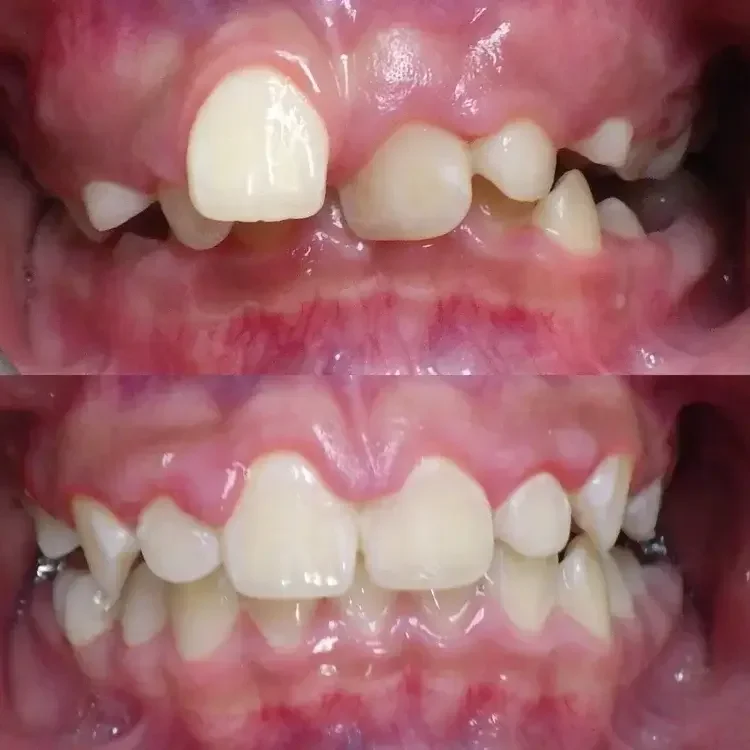
Crowding in the mixed-teeth stage is one of the things an early orthodontic check looks at.
What an orthodontist might recommend
For most children, the answer is monitoring. We check again as more adult teeth come in.
If there's a problem that will be harder to fix later, such as severe crowding, a narrow upper jaw or a crossbite, early treatment may help. Phase I orthodontics is usually for children between 7 and 10 and typically lasts 9 to 12 months. It might involve an expander, partial braces, a space maintainer or a removable plate to make room for the adult teeth. It isn't the same as full braces, which usually come later, if they're needed at all.
At Textbook Orthodontics, Dr. Nathan Nourian treats every child personally. If waiting is the better option, he'll say so. Our guide to when to monitor and when to treat early explains how that decision is made.
Cost and coverage for families
Phase I treatment typically costs $2,000 to $3,000, depending on the appliances used and how long treatment lasts. Kids' braces start from $87 a month with 0% interest financing. The practice accepts most PPO plans and is one of the few private practices in LA accepting Medi-Cal for qualifying minors with medically necessary cases.
Frequently asked questions
Will the adult tooth move forward on its own?
Usually, yes. Once the baby tooth is out, the tongue tends to push the adult tooth forward into place over a few weeks.
Should I pull the baby tooth out myself?
Only if it's very loose and comes out easily. A firm baby tooth should be left for your dentist to assess.
Does a double row mean my child will need braces?
Not necessarily. It can be a sign of crowding, which is why an orthodontic check by age 7 is a good idea, but many children never need treatment for it.
Does it hurt?
Usually not. Some children feel a little tenderness around the gum where the adult tooth is coming through, which settles on its own.
What happens at a first orthodontic check?
We look at your child's teeth, bite and jaw growth, take digital X-rays and photographs and explain whether anything needs doing now, later or not at all.
Book a children's orthodontics check in Los Angeles County
The first consultation is free and includes digital X-rays, photographs and a plan built around your child. Book a visit for children's orthodontics in Los Angeles County at the office nearest you.
Panorama City: 8424 Van Nuys Blvd, Panorama City, CA 91402. Call (818) 510-3440.
Los Angeles: 1563 S. Western Ave, Los Angeles, CA 90006. Call (213) 933-6370.
Hawthorne: 14248 Hawthorne Blvd, Hawthorne, CA 90250. Call (310) 751-3098.
Whittier: 14564 Whittier Blvd, Whittier, CA 90605. Call (562) 693-8202.
Book a free consultation: https://textbookorthodontics.com/consultation