
Why Your Orthodontist Checks Your Airway, Posture, and Facial Balance: Not Just Crooked Teeth
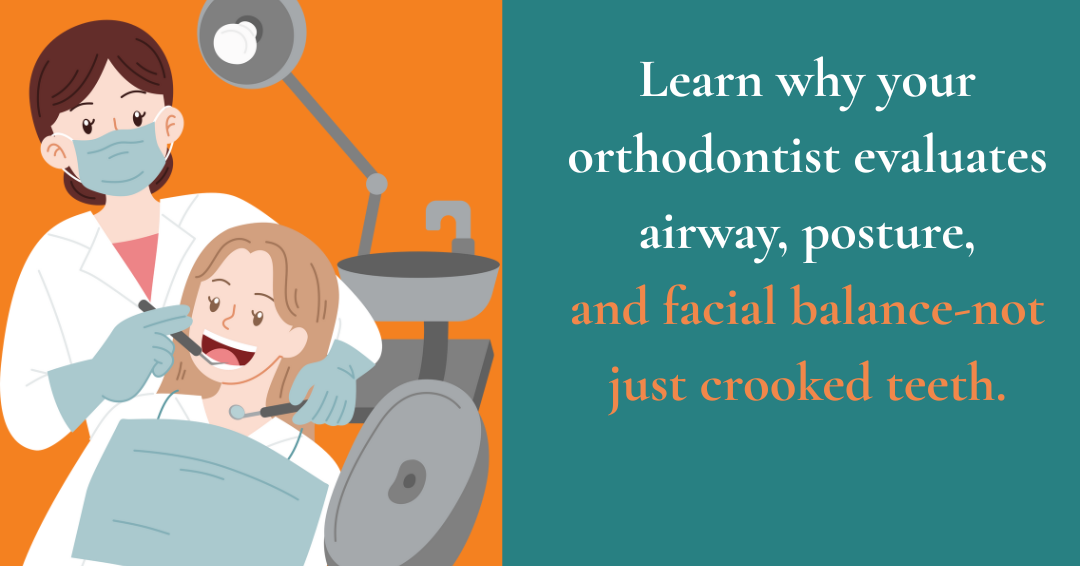
Many people visit an orthodontist because they notice crowded teeth, gaps, or a bite that feels “off.” But there’s a lot more happening behind the scenes during that first exam. Before we talk about brackets, aligners, or treatment plans, we take time to study how your entire face, jaw, and airway are working together. At Textbook Orthodontics, we believe a healthy smile starts long before a tooth ever moves.
This approach surprises many patients, but it also helps them understand why an orthodontist checks areas that may seem unrelated to teeth. The truth is simple: every part of your mouth connects to how you breathe, chew, speak, and even sleep.
Let’s break down the key areas we evaluate, and why they matter for your long-term health.
1. Your Airway: How You Breathe Shapes Your Smile
One of the first things an orthodontist looks at is how well you breathe through your nose. Breathing through the nose helps guide proper jaw growth in kids and supports good sleep and energy levels in adults. When the airway is narrow or blocked, the body often switches to mouth breathing.
This may look harmless, but over time, mouth breathing can lead to:
● A long, narrow face
● A high, narrow palate
● Crowded teeth
● Improper tongue position
● Poor sleep quality
We check the airway because breathing problems can slow down orthodontic progress or cause teeth to shift back after treatment. If we spot something that needs attention, like enlarged tonsils, nasal blockage, or tongue-tie, we discuss options so your smile and airway work well together.
This is one way an orthodontist helps protect not only the look of your smile but your overall health.
2. Tongue Posture: A Silent Force That Shapes the Jaw
Most people don’t realize how powerful the tongue is. It rests against the roof of the mouth and helps guide the upper jaw as a child grows. When the tongue sits too low, is weak, or cannot lift properly, the jaw may not widen the way it should.
During your visit, we gently check:
● Where the tongue rests
● Whether it seals during swallowing
● If a tongue-tie limits movement
A healthy tongue posture supports wide arches, balanced facial shape, and straight teeth. We may recommend simple exercises, therapy, or a collaborative approach with other providers.
Understanding tongue posture is one of the reasons an orthodontist looks beyond what you see in the mirror.
3. Posture and Head Position: Your Spine Affects Your Bite
It may sound unrelated, but your neck and head position affect how your jaw closes. Forward head posture, common with long hours on phones, tablets, and computers, can cause the lower jaw to shift backwards. This may lead to:
● A deep bite
● TMJ discomfort
● Bite imbalance
● Tired facial muscles
When we study posture during an orthodontic exam, we’re checking how your whole body supports your smile. Sometimes even a small adjustment can improve comfort and help treatment move more smoothly.
This whole-body approach is one way an orthodontist builds a stable foundation before moving any teeth.
4. TMJ Screening: Protecting Your Joints Before Treatment Begins
The TMJ (temporomandibular joint) works like a hinge that lets your mouth open, close, and move side to side. If the joint isn’t stable, orthodontic treatment may cause discomfort or slow down progress.
This is why we check for:
● Clicking or popping
● Grinding or clenching
● Soreness in the jaw
● Limited opening
● Headaches around the temples
We want to understand how the joint behaves when you bite and chew. A stable TMJ helps create a stable smile. An orthodontist who checks your jaw joints is making sure your treatment builds comfort into your everyday life.
5. Facial Balance: The Symmetry That Supports a Beautiful Smile
Straight teeth are only part of what makes a smile look natural. During a facial balance check, we study how your lips, chin, cheeks, and jawline work together. Even small changes in tooth position can improve harmony across the entire face.
We focus on:
● Smile arc
● Midline alignment
● Chin position
● Lip support
● Cheek width
● Profile balance
This gives us a clear picture of how to move your teeth in a way that supports both health and appearance. A detailed facial analysis helps your orthodontist create a plan that fits your unique structure.
6. Skeletal Patterns: How Your Jaws Fit Together
Your upper and lower jaws are the foundation of your bite. If the bones are too far forward, too far back, or not wide enough, it affects how the teeth meet. That’s why we measure your bite from several angles using photos, scans, and models.
We look for:
● Overbite and overjet
● Width differences
● Growth direction in kids
● Stability concerns in adults
Understanding these patterns helps the orthodontist choose the right tools, braces, Invisalign, elastics, or growth-guided treatment to move your teeth safely and predictably.
Your Smile Is Connected to Your Whole Body
At Textbook Orthodontics, we take this wider view because your teeth don’t work alone. Breathing, posture, jaw joints, tongue position, and facial balance all play a role in how your smile looks and feels. When an orthodontist studies these areas closely, treatment becomes smoother, more comfortable, and more stable long term.
If you’re curious about how your airway, posture, or facial balance might be shaping your smile, we’re here to help. You can schedule a visit anytime through our website, and we’ll walk you through your full smile and health assessment step by step.
